




Glass office partitions vs. drywall: which is right for your office?
When you divide up an office, you’re really choosing between two philosophies: the solid, permanent drywall wall, or the light, flexible glass partition. Both create rooms; they behave very differently on cost, daylight, acoustics and how easily you can change your mind later. Here’s how they compare for a Toronto workplace.
Natural light
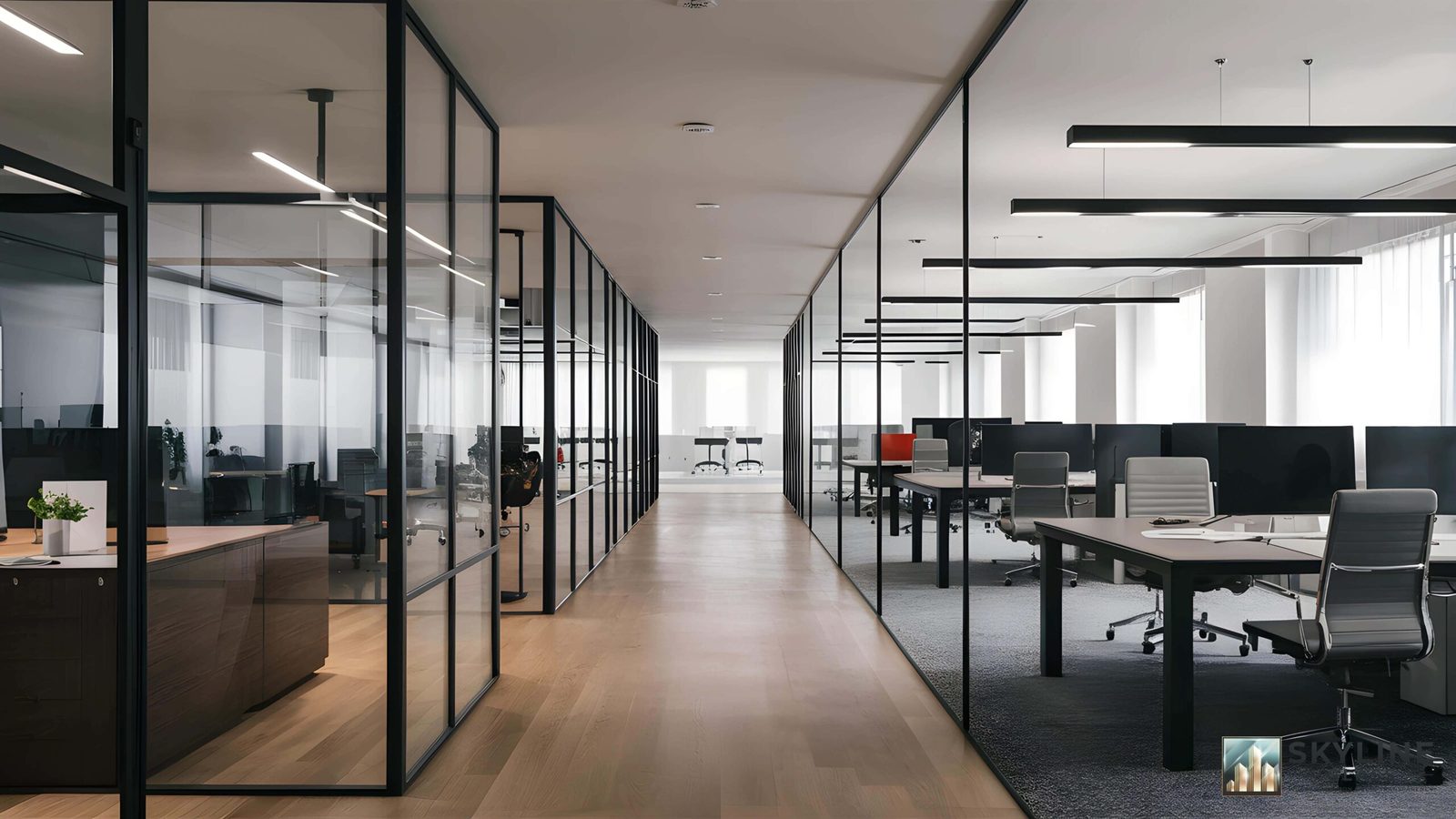
This is glass’s headline advantage. A glass partition lets daylight from the perimeter windows travel deep into the floorplate, so interior desks and corridors don’t become dim, closed-in spaces. Drywall blocks that light completely, which is why heavily walled offices so often feel like a maze of dark boxes and rely on more artificial lighting. For staff wellbeing and energy use, borrowed daylight is a real, measurable benefit.
Cost
Up front, drywall is usually the cheaper build per square foot — framing, board, tape, mud and paint are inexpensive materials. Glass partitions cost more per square foot (commonly $40–$110 installed depending on glazing and framing). But the comparison isn’t only about installation day: drywall changes mean demolition, dust, patching and repainting, while a demountable glass system can be reconfigured and even relocated. Over a few churn cycles, glass often wins on total cost of ownership — especially in leased space.
Flexibility
Businesses change — teams grow, departments merge, a boardroom needs to become two offices. Reworking drywall is a construction project: noise, dust, downtime and repainting. Demountable glass partitions unclip and move, often over a weekend, with no mess. If your floorplan is likely to change, or you’re in leased space you may need to return to base condition, that flexibility is worth a lot.
Acoustics
This is the one area where people assume drywall wins — and a basic single-glazed partition is indeed less private than a well-built insulated drywall wall. But a double-glazed acoustic glass partition with proper seals closes most of that gap and delivers genuine speech privacy for offices and meeting rooms. The trick is specifying the right glass and seals for the room; a good installer tunes acoustics to each space rather than treating all glass the same.
Look and impression
Glass reads as modern, transparent and premium — it signals an open, confident culture, and it photographs beautifully for clients and recruiting. Drywall is neutral and can be finished any colour, but it closes a space down visually. Many offices land on a hybrid: glass on the fronts of meeting rooms and offices for light and openness, with a few drywall walls where full privacy or a solid surface (for screens or acoustics) is needed.
Privacy and branding
Worried about fishbowl offices? Glass handles privacy gracefully. Frosted or acid-etched glass, gradient bands and printed manifestation film give privacy at seated height while keeping light above, and the film can carry your logo, wayfinding or a custom pattern — turning a partition into a branding surface a drywall wall could never be. Manifestation film also does double duty as a safety marker so people don’t walk into clear glass, and it’s inexpensive to update if your branding changes or you want a different look down the line — a flexibility a painted drywall wall doesn’t offer.
Installation and downtime
Building drywall in an occupied office means dust, noise and days of trades — framing, boarding, taping, sanding, painting and curing — often behind poly sheeting while staff work around it. Glass partitions arrive pre-fabricated to shop drawings and go up cleanly, frequently after hours or over a weekend, so the office is ready Monday. Less mess and less downtime is a real, if easily overlooked, cost saving — particularly in a working office you can’t simply shut down.
Sustainability and re-use
There’s an environmental angle too. Demountable glass partitions can be dismantled and re-used when you move or reconfigure, whereas demolished drywall is largely landfill. Glass also reduces daytime lighting loads by carrying daylight through the floor. For firms chasing LEED or WELL credits, both the daylight access and the reusability of a demountable system can contribute — worth raising with your designer early.
A quick cost-of-ownership example
Imagine a leased floor that reorganises twice over a five-year term. With drywall, each change is a mini-construction project — demolition, disposal, rebuild, repaint. With demountable glass, the same changes are largely a matter of unclipping and relocating panels, and the partitions may even come with you or be returned to base condition at lease-end. The higher day-one glass price can be offset by avoiding those repeated drywall rebuilds.
Which should you choose?
- Choose glass partitions for meeting-room and office fronts, open collaborative floors, leased space that may change, and any office where daylight, flexibility and a modern impression matter.
- Choose drywall for walls that need maximum acoustic isolation, a mounting surface for heavy screens or millwork, or permanent core areas that will never move.
- Choose a hybrid — the most common answer — to get glass where it’s seen and drywall where it’s needed.
The right mix depends on your lease, your headcount trajectory and how much the floor is likely to change — which is exactly what we help you think through at the site measure, before any glass or framing is ordered.
Quick answers
Are glass partitions cheaper than drywall? Not on day one — drywall is usually cheaper to build, but glass can win over time thanks to reconfiguration and re-use. Do they block sound? Single glazing dampens noise; double-glazed acoustic partitions give genuine speech privacy. Can you see straight through? Only if you want to — frosting, gradient film and blinds handle privacy. Can we move them later? Yes, with a demountable system. Do they take long to install? No — pre-fabricated panels go up cleanly, often after hours.
Get shop drawings and a fixed quote
Skyline Glass designs, supplies and installs glass partition walls and office partitions across Toronto and the GTA, with shop drawings and a fixed price after a site measure. Explore office glass partitions in Toronto, related glass storefronts, or book a site measure to talk through your fit-out.